Libellés

Affichage des articles dont le libellé est France. Afficher tous les articles

samedi 19 avril 2014

In the middle of nowhere and at the heart of Provence

Metropolitan France is divided into regions, which in turn are sub-divided into 96 departments. Each French departement carries the name of its main characteristic - usually its main geographical feature, such as an important river or mountain. While its useful for tourists to know exactly which attractions they should visit when entering a department, having 96 departments in a little country can get confusing sometimes. Especially when your friends refer to them by number.

"So, where do you come from?"
"Oh, not far. I'm from 04."
"Ahaaam. . ."

And then the clueless gringo takes out his portable French map and looks up the corresponding number. If you happen to take maps with you to parties, of course.

The 96 departments are listed alphabetical order, but are spread out over the territory. Vaucluse is in red.
But other than impressing your friends by knowing French geography, there is really only one thing you should know about the French department numbers, which is: Don't go into Marseille if your license plate ends with the numbers 75. Seriously. Parisiens are not well treated down here.

That said, I didn't have high expectations when entering the department of Vaucluse. As far as I knew, the name "Vaucluse" didn't mean a river, mountain, or anything else potentially exciting for an environmental scientist. I expected to encounter a very boring, middle-of-nowhere land where grass didn't grow very high because goats were constantly eating it.

What I did find was a beautiful blue river, the prettiest red rocks I've ever seen, and a sign saying : IT IS FORBIDDEN TO BOTHER THE VIPERS.

I thought it was a joke, but no. Vipers do exist in France.

Vallis Clausa, the origins of Vaucluse.
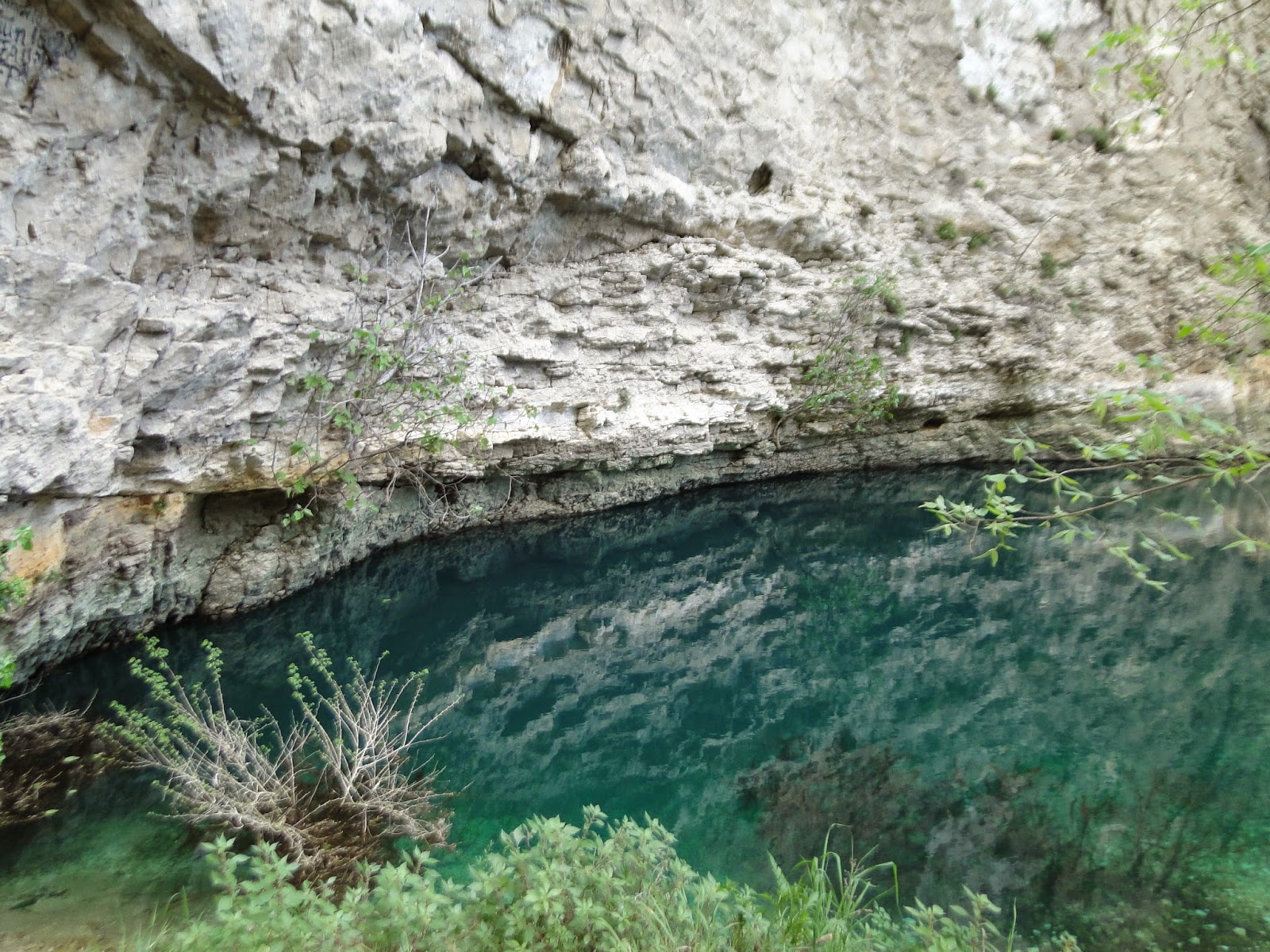
The name Vaucluse comes from "Vallis Clausa", which is Provençal for "closed valley". It gets its names from a closed valley (no, really?) but what's remarkable about it is the karstic network. Basically, the rock formation drains rainwater underground and it all springs out of the Earth at one spot : the "Fountain of Vaucluse". It looks like an innocent glassy blue lake. But it drains a watershed of an area of 1000 km², forming the Sorgue river.

"Vaucluse" should really be named "Blue River of Paradise". Really. 

Today it's an important tourist attraction, and the city of "Fontaine de Vaucluse" knows how to handle the attention. You'll find a short scenic path winding up a gentle slopewith craggy mountains following you on each side, bordered by the lovely Sorgue river on the right and provencial boutiques on the right. The ice cream is particularly notorious.

A typical view from the path.
And if you have time to spare in this lovely department, don't miss the Ochres of Provence. They are red/orange colored rocks that rival those of the Grand Canyon, except on a smaller scale. The rocks' odd colors come from millions of years ago, when France was covered by a tropical forest. For centuries, mining companies plowed these lands to extract color pigments from the ochres. Today, most of them are in disuse, as natural color pigments have been gradually substituted for chemical compounds. The sites have left colorful scars across in Provencial Colorado, and today, it is another profitable tourist attraction.

Colorado Provençal
An old mining site at Roussillon
Unless, of course, you study environmental science and your school takes you to these sites for free ;) But that's not to say that it's all fun and games- we study hard. The fountain of Vaucluse, for example, is a classic portrait of what I'm currently researching - karstic networks that drain water from large watersheds. Who's to say that beauty and work can't be together?

As a friend of mine said, "It's a magical place. You ask yourself- where does the water come from? As a scientist, I know, but I still like to believe that it's unreal."


Thanks Seb for his English interview and for my GERIMA class that I'm so proud of, because they make these experiences unforgettable. 

lundi 14 avril 2014

10 reasons to love Marseille

Last week I told you about Marseille's story- the immigrant's city. Now here's a list that will change your heart about this city and make you want to live here.

#1. Marseille is all about blue. Blue cloudless skies, blue sea, blue butterflies. I've never seen so much beautiful blue in my life before moving here. Imagine waking up everyday during summer and seeing a gorgeous, blue sky outside that invites you to take a dip in the clear, blue sea. Now that's pretty close to paradise.


#2. Marseille breathes. Marseille has 800,000 people and within one year, you will know half of them.
Brazilian protest in June, 2012
Vieux Port during a busy spring Saturday. March, 2014.
Fire festival in April, 2013


#3. Marseille is an ancient Greek colony and its architecture doesn't let you forget it.


#4. Marseille has the best park in the world. No, seriously. In what other park do you see peacocks, green wild parrots, large woody areas, a lake, and grassy plains where children can play and college students can study? Oh, and top it off with a rose garden and everyone speaking in French. That, ladies and gentlemen, is Parc Borély.


#5. Ever heard of someone saying that it's not possible to surf in the Mediterranean? Here in Marseille, you can.


#6. Pretty sunsets. Every time there is a sunny day. That'll be about 300 sunsets per year.


#7. Marseille has free boat rides if you have a transport card.

#8. Within a couple of hours you can be across the country by TGV.


#9. There is a piano in the Saint Charles train station in Marseille, which anyone can sit down and play.


And finally, number 10, this is how my classroom looks like.


mardi 8 avril 2014

Marseille, an immigrant's tale

Marseille is an immigrant's city.

I'm not saying this because there are a lot of foreigners here. There are a lot of foreigners. There are a lot of Maghrebian people who cross the Mediterranean and don't go much farther than Marseille's Vieux Port. But there are also Germans, Spanish, Brazilians, Chinese, Italians- people who like me, were attracted to Marseille as if the Notre Dame de la Garde had a beacon attached to it with a sign saying: WELCOME, FOREIGNERS.

WELCOME, FOREIGNERS! Drop your luggage here!

However, there are also a lot of French immigrants here. In fact, almost everyone I've talked to in Marseille is an immigrant of some form. Rare is the one who has spent its entire life in Marseille. Everyone in my class at Aix-Marseille Univeristy, for example, came from a different region in France and for different reasons, ended up in Marseille.

But we all have something in common- we all want to get out.

Marseille is the passing-through city. No one really wanted to be here in the first place, and is just using the city as a means to accomplish something. It might be to finish one's studies at the university. It might be to find a job in one of the France's most diverse cities. It might be in pursuit of the sun or a love affair. I've seen everything in these two years that I've been living here, and one thing is for certain- Marseille is not dull.

But once the person's objective is accomplished, it's Au revoir, Marseille. This is not a city you dream of living in. And, because no one wants to keep living in Marseille, it continues to be treated the way it is- like the common room of your boarding school. It's fun to use it, but since it's not yours, you don't exactly keep it clean and decorate it with flowers.

That's not to say Marseille isn't beautiful. I mean, look at this:

Sugiton, Marseille.

And this:

Les Goudes, Marseille

Marseille is colorful, Marseille has nature, Marseille has spirit. Marseille has all that and the benefits of being a large city like Paris, except it's in the South, it has cleaner air and 300 days of sunshine per year. And it's just next to Provence so we get to have cheap lavender, soap, and olive oil.


If Julia Roberts said in Eat, Pray, and Love that all cities have a word, Marseille's is transit. And I couldn't think of a more lovelier, exciting city to be in during my transit time.

mercredi 20 novembre 2013

The motivation to play

The French flag- photo by me.

Soccer. Everyone knows it's not about two teams chasing a ball around from one side to another while releasing healthy endorphins. When we're talking about the World Cup, it's about countries competing against each other. Who is the best? Who invests more in education and sports programs? Who gives their citizens the better chance to develop their abilities?

So why do we see certain developing countries excel at soccer?

This question came to me yesterday as I was watching a decisive soccer game : France vs. Ukraine. It was the last chance of either country to be qualified to play in the World Cup '14. The French were downhearted, because their country had been brutally beaten by Ukraine in their last game (2x0). The 80 thousand spectators at the Stade de France were dressed head to toe in red white and blue, but their eyes were all transmitting the same doubt : are we going to make it? And for goodness' sake, why did we have to lose to Ukraine?

This is coming from a country whose team went to the finals a mere 8 years ago against Italy. The French team is notably one of the best of the world. It was a surprise to all that this year, the French just might not qualify due to the prowess of other countries.

But when you look at the background stories, you begin to understand why. France is already a developed country with a valorized sports program, an excellent education system, and accesible health care. The majority of its citizens are well cared-for. There are excellent atheletes that want to play soccer for a profession and to show off their patriotism- but that's it. 

While in countries like Ukraine, people are still struggling to ascend socially and financially. Corruption is still a big part of their daily lives. Those who choose to play soccer as a profession have more drive and more at stake - if they succeed, they may enter the world of the rich. If they don't, they might be condemned to spend life in misery.

Take a look at Brazil. Back in the 50's and 60's, Brazil had the best team in the world, proven by their numerous Cups - 3 won in 12 years! At that time, Brazil was still a growing country. Most of its players came from its poorest neighborhoods. Boys would learn to play soccer with a makeshift ball, but they had big dreams. For some of these boys, their dreams came true.

Today, reality has changed in Brazil. Life has improved for the majority of its citizens, though the clash between the rich and the poor is still pronounced. But today, there aren't little boys dotting the dirt streets with a rubber ball tucked under their arms. They've been replaced by the oppressed lives of favelas, or shanty towns, where smuggling drugs is the new trend. Making big money is still a dream for most, but there are other ways to attain it. Many, illegal.

The motivation that once existed in Brazil to play soccer is lost. Many a Brazilian has shook its head, asking themselves what went wrong. But maybe nothing went wrong, and the motivation went elsewhere. Just like in France, where the level of patriotism is represented by how well the team plays soccer.

It turns out that in the end, patriotism wins. France beat Ukraine 3x0 much to the joy of the crowd. It wouldn't surprise me if François Hollande's popularity suddenly soared today. Sometimes the motivation comes from odd places, but it's better to have it than none at all.