Libellés

Affichage des articles dont le libellé est Brazil. Afficher tous les articles

vendredi 25 avril 2014

Cultural shock

Part of Tracking Stories is, actually,  tracking stories. What this means is that either I do some research, or ask other people about their life experiences, and hopefully write about something you haven't seen before. Thus, today's article is about cultural shock based on several experiences I've heard from people of different ethnic groups.

 Part of living on planet Earth is accepting that there are people who live in cultures that are radically different from yours and learning not to get offended by them. And part of living in other countries is getting to use cultural difference as an excuse for your weirdness.

"You mean that French don't drink tea five times a day? Well, that's just the way we do it in Brazil. . ." (NOT).

Below I've compiled a list of the most shocking cultural shocks that you might come across in your wordly travels.

#1. Greating people

This was the most fun and awkward cultural shock ever. Chances are that if you are American or Canadian (pratically the only two countries in the world to not engage in some sort of physical contact at greetings), you've experienced it too.

Horses by National Geographic. Photo by Anthony M. Tortoriello.

In most countries of Europe and in Brazil, people greet each other by kissing each other on the cheek. Usually there is no lip-cheek contact, and people press their cheeks together making kissing sounds. It sounds weird, but it's not.

To make matters more confusing, in Brazil, people greet each other with one kiss on the RIGHT cheek. In France, it's two kisses starting on the LEFT cheek. You can imagine the awkardness of trying to kiss the right cheek when you've recently changed from one country to another.

Even more complicated is that in France, depending in what region you live in, the number of "bisous" changes. People can give two, three, or even four kisses depending on their regional culture. Here in Marseille, the rule is two, but near Avignon which is just a hundred kilometers away, people greet each other with three kisses.

#2. See you at seven o'clock

Ah, the famous ponctuality and the fashionably-late statement. In which countries does seven o'clock mean seven o'clock?
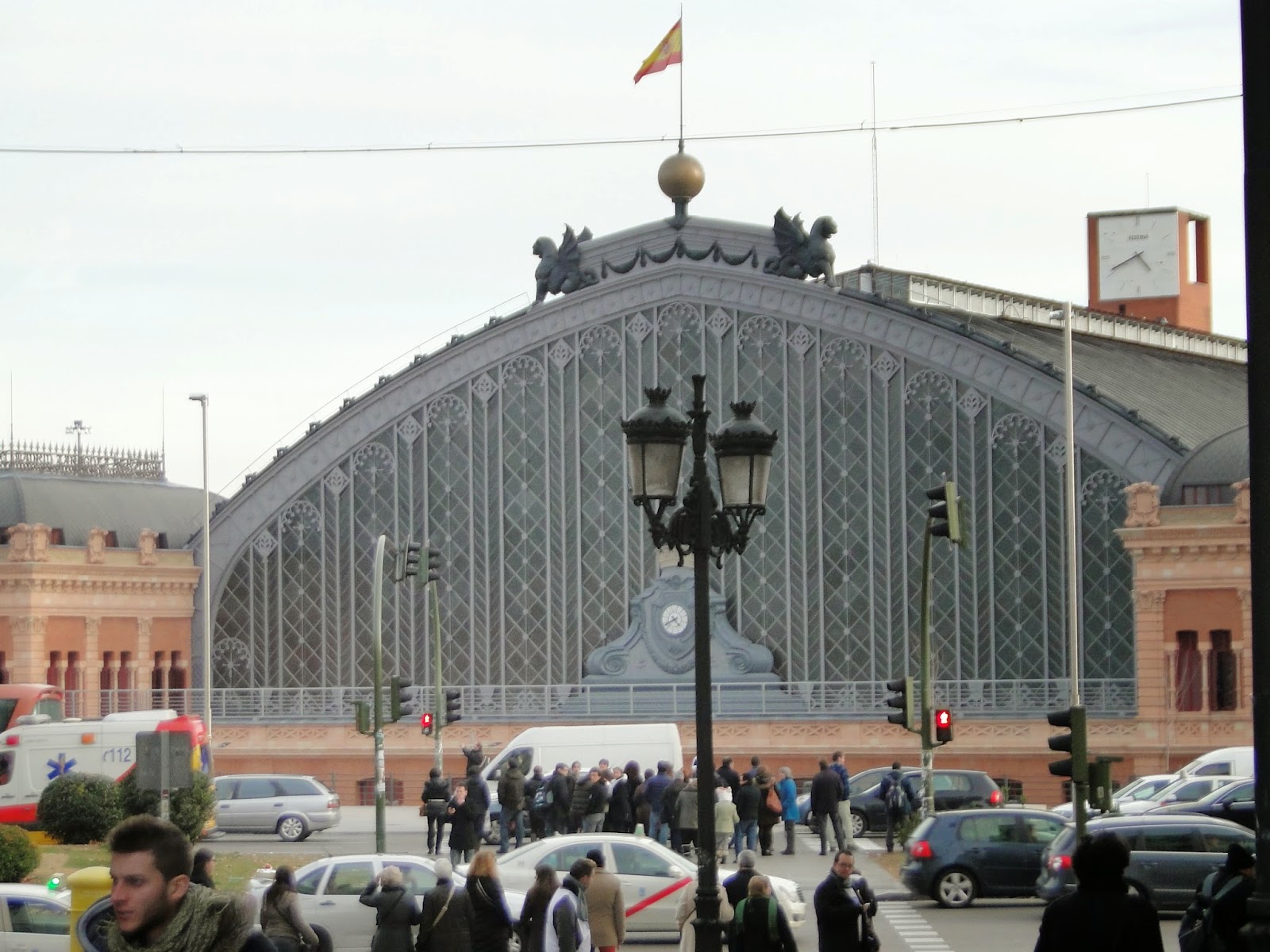
Atocha train station in Madrid, Spain
7:00 PM (as in, 'I will meet you at the café at 7:00').

USA: 6:55-7:03
France: 6:59-7:01
Russia: 7:15-7:20
Brazil: 7:30- ???

Being a radically ponctual person means spending a long, long time waiting for other people to show up in Brazil. But Brazilians don't mean harm by it. It's just part of Brazilian culture. This started with showing up a little late at events, so you get the 'best' of the party, the time that people are already tipsy but not too drunk. Unfortunately, this habit spread like wild-fire to the point that even when meeting a single person at a café, you can count on the person being late.

And in Russia, it isn't appreciated if you show up "early" at someone's house (by early, I mean seven o'clock sharp). Showing up fifteen minutes after the fixed rendez-vous gives the host time to prepare its house.

But as a general rule, it's safe to be ponctual (unless you're going to a Brazilian party, in which case you should be two hours late. Not kidding).


#3. When you're in a completely different universe that hasn't had contact with white people before

You've embarked on a journey to the end of the Earth on a do-gooder mission. The only problem is that when you finally meet the natives of the village you're visiting, they run away crying because they've never seen a white person before and they think you're a demon.

Harvest Festival in Swaziland. National Geographic, photo by Joyce McClure
This can happen on several different levels, whether you're visiting a neighboring country and everyone starts to stare at you funny when you wear sandals, to certain radical countries who may arrest you for your religion or political beliefs. The trick here is to know what to expect and when the unexpected happens, to handle it as calmly as possible.

#4. Hair 

 Another thing that may shock you when you cross hemispheres is how people (for fairness sake, I'll only mention the ladies) use their hair. Many, many girls pointed this out to me as being the first cultural shock they experienced when crossing the Equator (in both directions). But if you think about it, it's only a matter of resources. Americans have a wider variety of hair products at hand, so why not make life fun with a bit of chop n'dye? Brazilians, on the other hand, tend to care less about the actual color and length of the hair, but use other products (like bananas) to make it shinier. That said, American girls also tend to spend more time on their hair before leaving the house each morning, straightening/curling, as Brazilians tend to go with the towel-dry/shake hair method. While this obviously isn't true for all Americans and Brazilians, it gives you a general idea of how women's hair behave in these countries.


Brazilian actress Camila Pitanga. Source: Globo
American actress Jennifer Aniston. Source: Getty Images

#5. Snow

It's funny how snow is treated in different countries. The more rare snow is in a city, the more panicked the population becomes when there are a couple of flurries outside, and the more unprepared the city is in case there is a significant precipitation.

But what's even more funny is when your school has been canceled due to mere flurries in the South of France, while in the Alps, just a couple hundred kilometers away, people are still going to school if they have snow up to their knees. And in Russia, kids still go to school when it's -20°C outside. Talk about harsh.

Culture shock happens when you've moved from a non-snowy/snowy environment to one that's the complete opposite. No one shares your opinion of snow, and you're either the only one that's super enthusiastic about seeing lots of snow or laughing at what people call "winter".

What you think of snow (beautiful, dangerous, cold, annoying) also defines who you are and where you come from. And if you're from North-East Brazil, chances are you'll explode with happiness at the chance of seeing snowflakes, while a German will just shake its head and prepare its snowboots.
Snow dusting the mountain tops in Palhoça, Brazil, 2013. It probably hasn't snowed there in a hundred years. Source: Diario Catarinense

mercredi 20 novembre 2013

The motivation to play

The French flag- photo by me.

Soccer. Everyone knows it's not about two teams chasing a ball around from one side to another while releasing healthy endorphins. When we're talking about the World Cup, it's about countries competing against each other. Who is the best? Who invests more in education and sports programs? Who gives their citizens the better chance to develop their abilities?

So why do we see certain developing countries excel at soccer?

This question came to me yesterday as I was watching a decisive soccer game : France vs. Ukraine. It was the last chance of either country to be qualified to play in the World Cup '14. The French were downhearted, because their country had been brutally beaten by Ukraine in their last game (2x0). The 80 thousand spectators at the Stade de France were dressed head to toe in red white and blue, but their eyes were all transmitting the same doubt : are we going to make it? And for goodness' sake, why did we have to lose to Ukraine?

This is coming from a country whose team went to the finals a mere 8 years ago against Italy. The French team is notably one of the best of the world. It was a surprise to all that this year, the French just might not qualify due to the prowess of other countries.

But when you look at the background stories, you begin to understand why. France is already a developed country with a valorized sports program, an excellent education system, and accesible health care. The majority of its citizens are well cared-for. There are excellent atheletes that want to play soccer for a profession and to show off their patriotism- but that's it. 

While in countries like Ukraine, people are still struggling to ascend socially and financially. Corruption is still a big part of their daily lives. Those who choose to play soccer as a profession have more drive and more at stake - if they succeed, they may enter the world of the rich. If they don't, they might be condemned to spend life in misery.

Take a look at Brazil. Back in the 50's and 60's, Brazil had the best team in the world, proven by their numerous Cups - 3 won in 12 years! At that time, Brazil was still a growing country. Most of its players came from its poorest neighborhoods. Boys would learn to play soccer with a makeshift ball, but they had big dreams. For some of these boys, their dreams came true.

Today, reality has changed in Brazil. Life has improved for the majority of its citizens, though the clash between the rich and the poor is still pronounced. But today, there aren't little boys dotting the dirt streets with a rubber ball tucked under their arms. They've been replaced by the oppressed lives of favelas, or shanty towns, where smuggling drugs is the new trend. Making big money is still a dream for most, but there are other ways to attain it. Many, illegal.

The motivation that once existed in Brazil to play soccer is lost. Many a Brazilian has shook its head, asking themselves what went wrong. But maybe nothing went wrong, and the motivation went elsewhere. Just like in France, where the level of patriotism is represented by how well the team plays soccer.

It turns out that in the end, patriotism wins. France beat Ukraine 3x0 much to the joy of the crowd. It wouldn't surprise me if François Hollande's popularity suddenly soared today. Sometimes the motivation comes from odd places, but it's better to have it than none at all. 


dimanche 22 septembre 2013

It's not nature's fault

Here I was, studying Management of Natural Risks, when my family alerts me of a very real disaster going on not to far from where they live.
Blumenau on a sunny day, bordered by Rio Itajai. Photo from Wikicommons

My mother's family is from a cute little town called Blumenau, which means Field of Flowers in German, and is one of the German towns set up by pioneers in the late 19th century in Southern Brazil. You see, these German pioneers were practical. They knew that living near a water source would help them with their early development and getting started in a new country. So they picked a site next to a large river bend, built sturdy German houses, and named the town after flowers. It couldn't get much better than that.

But Brazilian climate tends to be a little more unpredictable. Southern Brazil is predominately Atlantic rainforest- or at least it is supposed to be. There is a large annual rainfall, electrical storms, and even some tornados off east. Once the riparian forest was gone, the river started swelling and causing enormous, catastrophic floods. The first recorded flood was September 23rd, 1880. The worst ones were in 1983 and 1984. My mom was a teen at that time. She remembers the streets becoming rivers and drinking water from the neighbor's swimming pool, because it was the only potable water left. 

Unfortunately, it wasn't the last. The last one was in 2008. It killed over a hundred people and moved thousands out of their homes. Many still don't have where to live. I've seen stories on tv of people that have no idea what to do next. They shake their fists into the air, wondering why this happened to them.

While it might not be their fault that they lived in such a precarious position, it certainly isn't nature's fault. This is Brazil. This is a climate that is used to very rainy seasons that may pop up once a century or twenty times. It's unpredictable. You cannot, and must not, do anything to change that.

What you can do is to reduce its consequences. It's the first thing I learned on my very first day of class this year : Risks are there. You can't change them. Earthquakes will happen, volcanoes will spew lava, rain might fall for 40 days and cause a flood. Earth is like that. We have to learn to live with it instead of fighting it. Luckily, most of these events are predictable. The Japonese have learned to deal with earthquakes by building seismic-proof buildings. The Dutch have built dikes to keep their country from disappearing bit by bit. 

Unfortunately for those who live in Blumenau, it's very hard to deal with this particular risk. Those who live on low lands often don't have the choice of moving elsewhere. The high lands are too far from the city and there's not enough money to move away. Sometimes the solution is asking for the government to step in and offer solutions : maybe subsidizing building companies to construct other buildings on the highlands, and connecting it with a good transport system so they won't be cut off from the city. Maybe it's making a system so that those who do construct on forbidden land are penalized. What I do know is that it's necessary to create a fool-proof risk system so that accidents like these don't happen again.

Because it will rain again. And again, and again. The trees love it, and so does the entire ecosystem. What can I say? It's a little piece of paradise down there. I just hope that people will protect it and not get mad at it.

These two guys were chilling out near São Martinho, Brazil. Lime green toucans are common in the Atlantic Rainforest.